
Last updated November 23, 2026
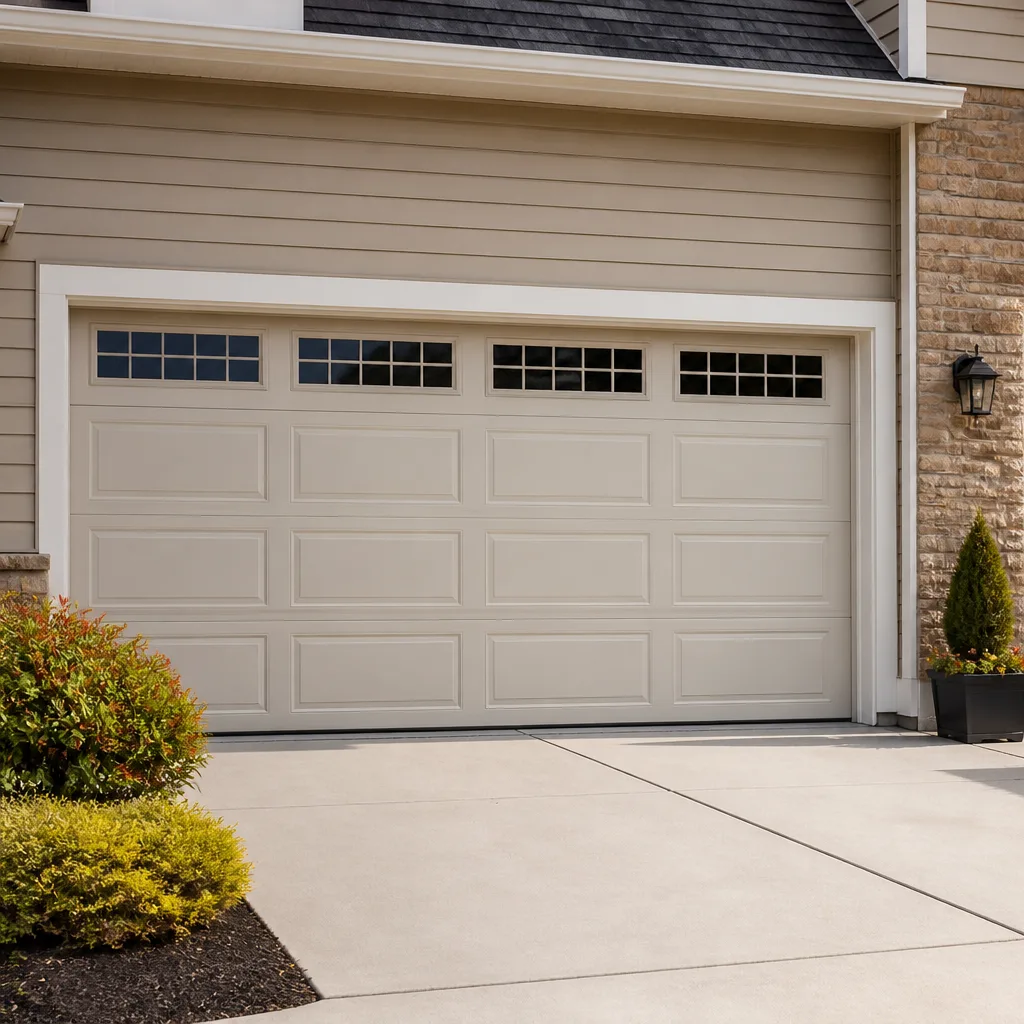 Raised-panel steel
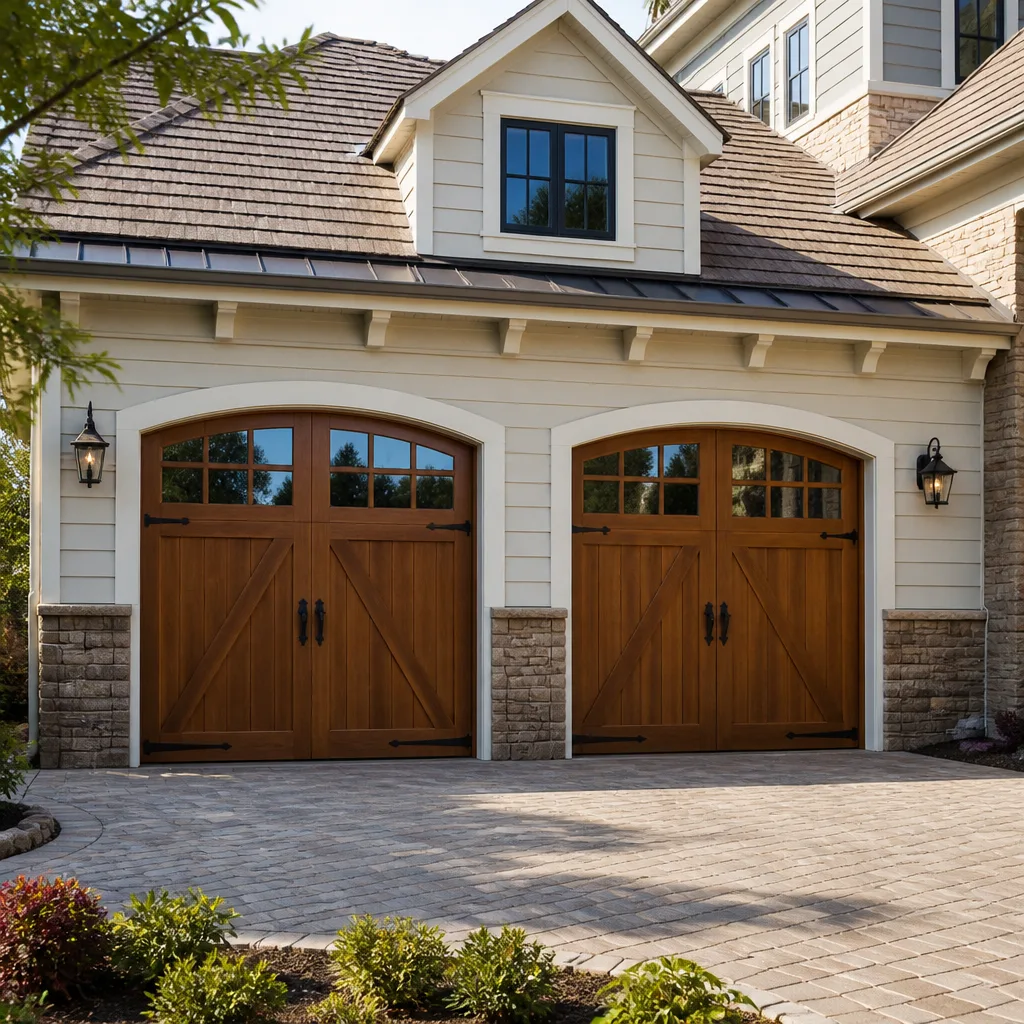 Carriage house
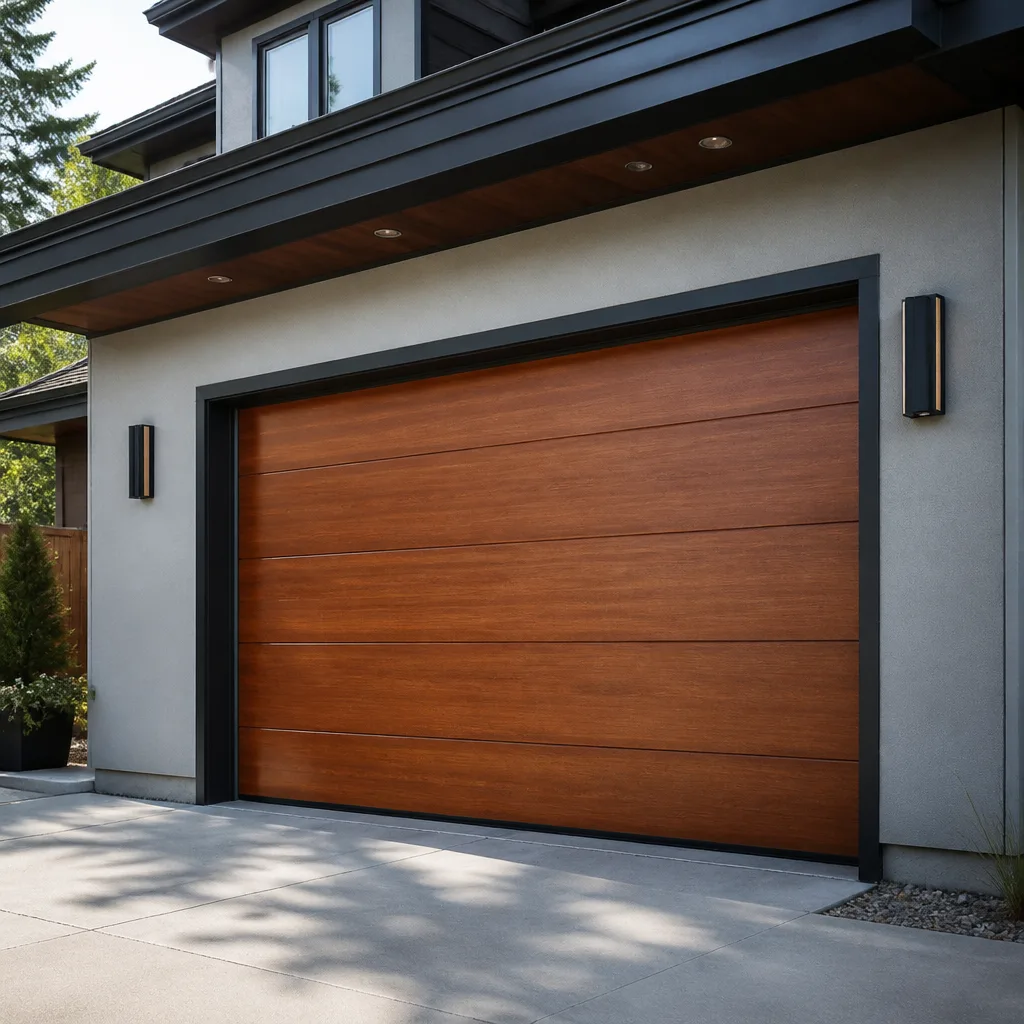 Modern flush
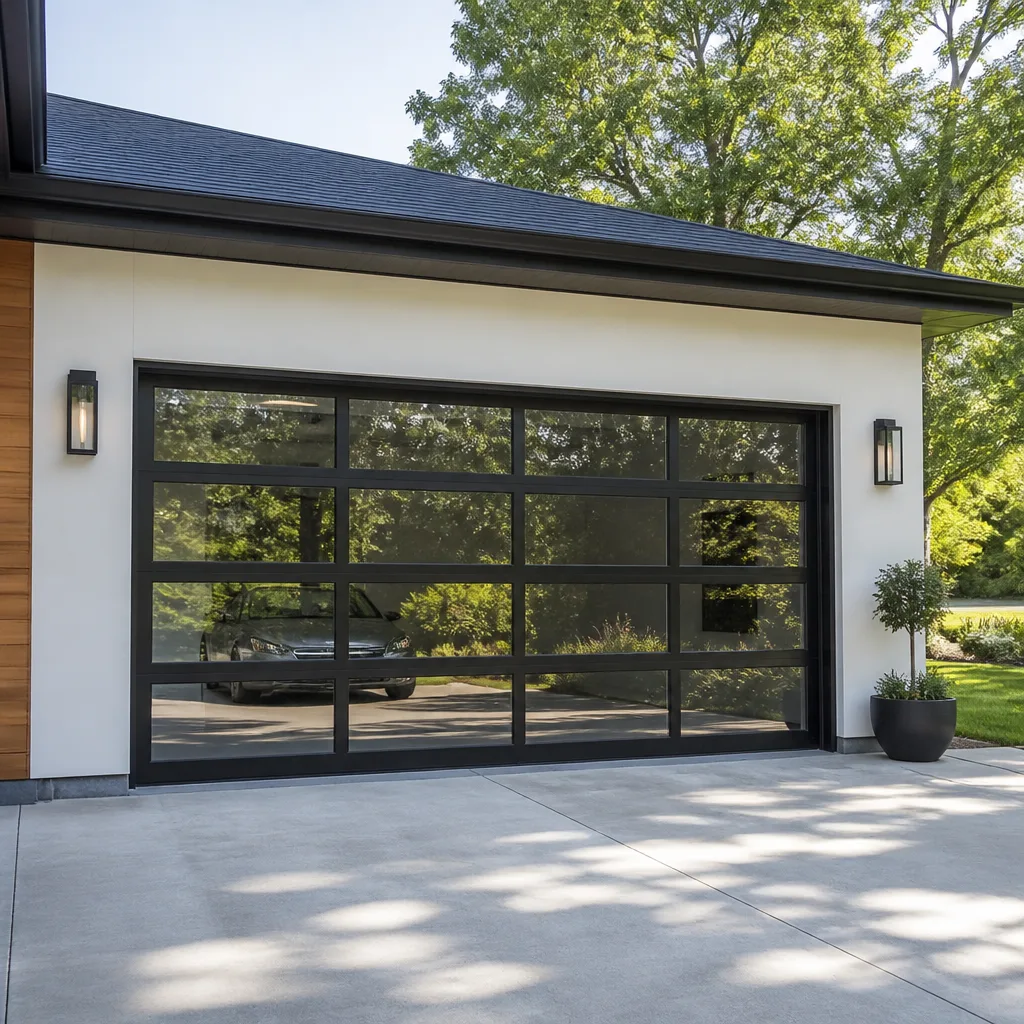 Full-view glass
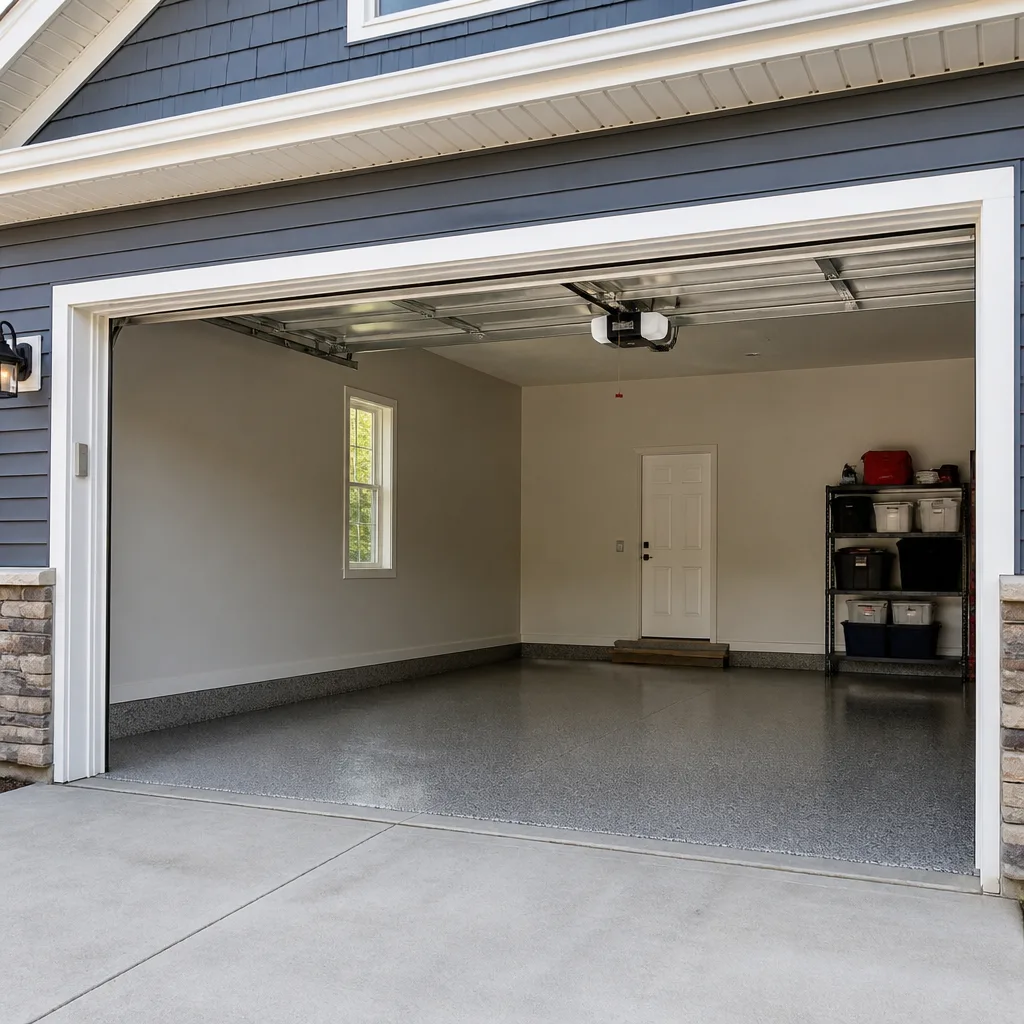 LiftMaster openers
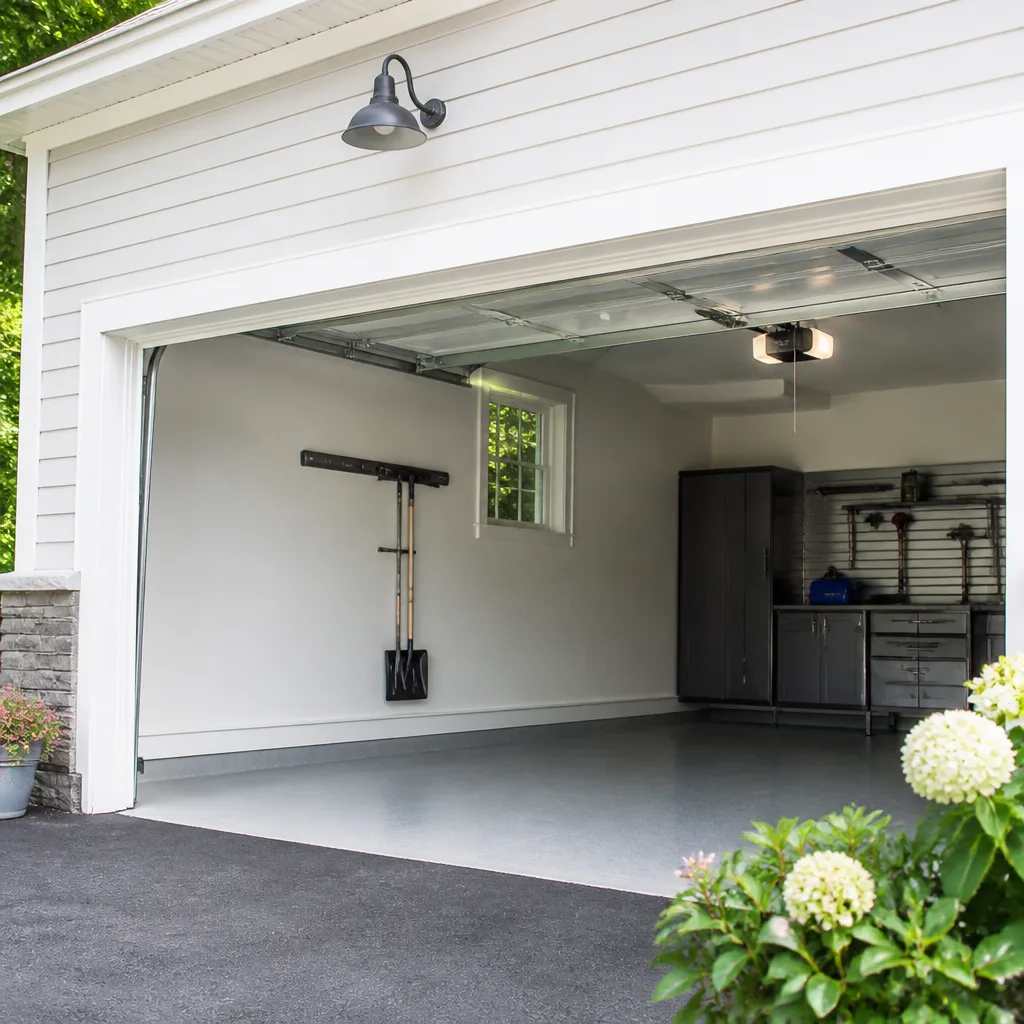 Chamberlain openers
Full 25-point door and opener safety check with every visit - springs, cables, rollers, tracks, and your LiftMaster or Chamberlain opener included
You get a price before we start. It does not change when the pro arrives.
Get your free estimateDIY vs Professional Garage Door: The Apopka Homeowner’s Decision Guide
Most garage door advice splits into two useless camps: “never touch it, call a pro” or “YouTube it, you’ll be fine.” Neither is honest. A torsion spring stores enough energy to seriously hurt you when it releases, and that’s not a scare tactic, it’s physics. But replacing a bottom weatherstrip or reprogramming an opener remote is something plenty of Apopka homeowners handle in an afternoon without a second thought. This guide draws the line where it actually belongs: task by task, tool by tool, and code by code. You’ll learn what’s safe to do yourself, what requires professional tools, what Florida building code keeps out of your hands, and how to tell the difference before you start.
Quick Answer
For an Apopka homeowner, most garage door tasks fall into three buckets. Cosmetic and low-tension work (weatherstripping, lubrication, opener programming, visual inspections) is safe DIY territory. Spring, cable, and high-tension hardware work is not: it’s the highest-injury job in the trade and belongs with a trained technician. Anything involving a new door installation, structural modifications, or electrical work on an opener that ties into household wiring is best handled by a licensed professional who can pull the right permits.
Styles & brands we work with
- Raised-panel steel
- Carriage house
- Modern flush
- Full-view glass
- LiftMaster openers
- Chamberlain openers
Table of Contents
- The Three-Bucket Rule: Sorting Every Garage Door Task
- What’s Safe to DIY in Apopka
- The Danger Zone: Springs, Cables, and Torsion Hardware
- Which Opener Brands Are Homeowner-Friendly vs Technician-Only
- What Florida Code Takes Out of Your Hands
- How an Unpermitted DIY Installation Affects Your Orange County Insurance
- Three Maintenance Tasks Every Apopka Homeowner Should Do Themselves
- The Real Cost of a DIY Spring Replacement Gone Wrong
The Three-Bucket Rule: Sorting Every Garage Door Task
Before you pick up a wrench, sort the job into one of three buckets. This single habit prevents most garage door injuries and most wasted weekends.
Bucket 1: Green (safe DIY). These are low-tension, low-height, low-risk tasks. Weatherstripping, lubricating hinges and rollers, tightening track bolts, cleaning photo-eye lenses, aligning safety sensors, and programming a new remote. No stored energy beyond a gentle extension spring on the smallest doors.
Bucket 2: Yellow (needs professional tools and technique). These involve calibrated tension or alignment. Track realignment after a car bump, roller replacement on a heavy insulated door, extension spring replacement, opener limit switch adjustment, and gear or logic board replacement inside the opener housing.
Bucket 3: Red (do not attempt). Torsion spring replacement, cable replacement or re-spooling, panel replacement on a pressurized or insulated door, bottom bracket work, and any wiring that ties the opener to your home’s electrical panel. These carry real injury risk and, in a few cases, legal risk.
Notice what’s not in the red bucket: the door itself. A lot of Apopka homeowners assume they can’t even open a panel for inspection. You can. What you can’t do safely is touch anything holding the door’s weight. That’s the dividing line.
What’s Safe to DIY in Apopka
Here’s the honest short list of tasks most homeowners can complete themselves without a technician and without risk:
- Replacing bottom weatherstrip: pulls out of a channel, presses back in, no tools beyond a flathead screwdriver.
- Lubricating hinges, rollers, and springs: a few drops of garage door lubricant on pivot points every six months. Not WD-40. Actual door lubricant.
- Aligning photo-eye safety sensors: if the door reverses on its own, the sensors at the bottom corners are usually nudged out of alignment. Twist the bracket until the indicator light on each sensor glows steady.
- Programming a new remote: every modern opener has a learn button on the back of the motor head. Press it, then press the remote until the operator clicks or blinks.
- Cleaning the track: a rag and a stiff brush. Never oil the track itself; oil attracts grit and gums up the rollers.
- Tightening bracket bolts: check the bolts that hold the track brackets to the ceiling and wall. Loose bolts cause rattling, not failure.
- Visual inspection: look for frayed cables, worn rollers, sagging sections, and any spring with a visible gap. If you see any of those, stop and call.
None of this requires a truck, a special tool, or a permit. It’s the maintenance most garage doors get skipped on, which is why they fail early. In Apopka’s heat and humidity, weatherstripping dries out faster than homeowners expect, so bottom seals are worth checking twice a year, not once.
The Danger Zone: Springs, Cables, and Torsion Hardware
Torsion springs and cables hold the full weight of your door under tension. When they’re intact, they’re doing roughly the work of lifting a small car every time you press the button. When they fail, that energy releases in an instant. This is the part of the trade nobody should learn by trial and error.
The tools matter as much as the technique. A professional spring replacement uses winding bars made for the job: hardened steel rods sized to the spring drums. Homeowners using screwdrivers, punches, or homemade bars are the most common source of hand and wrist injuries from this repair. There’s no version of a torsion spring job that gets safer with improvised tools, and there’s no working angle that puts you out of the line of fire.
Cables are the same story. A snapped cable whipping loose can cause serious injury, and re-spooling a cable on a drum requires controlled tension on a live system. This is the reason spring repair is a dedicated service in the trade and not something folded into general handyman work. We see the aftermath of DIY attempts fairly often in Apopka, and the pattern is consistent: the door is fine, the spring is what breaks the DIYer’s wrist.
Do not cut, loosen, or adjust anything attached to a spring. Do not try to lift a door with a broken spring by hand. Call for repair. Our team handles garage door repair for Apopka homeowners, and the spring job is a routine one for us, not a novel puzzle.
Which Opener Brands Are Homeowner-Friendly vs Technician-Only
The opener is a different animal from the door. Some brands are straightforward for a homeowner to install and program. Others require calibration tools and firmware access that only a technician carries. If you’re considering a DIY opener swap, know what you’re walking into by brand.
Homeowner-friendly: Craftsman and Chamberlain models are the most forgiving. A belt-driven Craftsman or a Chamberlain with a straightforward learn button can typically be mounted and paired in an afternoon by a competent DIYer. The manual is well-written, and replacement parts are off-the-shelf. Raynor openers are also generally approachable for a first install, though the door-side setup matters more than the opener itself.
Technician-territory: LiftMaster, in particular, pairs better with a technician on install because the calibration for travel limits and force sensitivity needs a meter reading that isn’t typically supplied with the homeowner kit. Brands with built-in myQ or Wi-Fi commissioning require a working network handshake that can hang a DIY install for hours. If the opener ties into a wall-mounted console or a smart-home hub, most homeowners end up on the phone within the first evening.
If your opener is misbehaving but the door itself moves fine, the safest path is a repair call, not a swap. Our technicians work on LiftMaster, Chamberlain, Genie, Clopay, Amarr, Wayne Dalton, Craftsman, and Raynor systems, so whatever opener is already on your ceiling is one we can diagnose. We handle garage door opener repair as a matter of routine, and a repair is usually a better call than a DIY replacement when the motor itself is still healthy.
What Florida Code Takes Out of Your Hands
Florida building code and Orange County permitting rules draw a stricter line than most homeowners realize. Garage door replacement and structural modification typically require a permit. The permit is there to ensure the new door’s wind rating and anchoring meet the state’s high-wind standards, and a permitted install leaves a paper trail your insurer and any future buyer can verify.
Some work is legally restricted to licensed professionals. Electrical work that ties the opener motor to the household wiring falls under state electrical licensing rules, and that’s not a job that gets hand-waved with a homeowner permit. Structural work, like re-anchoring a track that pulled out of the framing, may require an inspection depending on the scope. This isn’t a gray area the city winks at: permitted work on a garage door is inspected, and unpermitted work can become a headache at resale.
Not every job needs a permit. A spring replacement, an opener repair, and routine maintenance usually don’t. If you’re not sure whether your job crosses the line, call Apopka’s building department directly and ask. They’ll tell you exactly what a permit covers for a garage door job at your address. It’s a five-minute call, and it’s the right one to make before you start.
Our technicians are trained and experienced on the entire install scope, including permitting coordination, and we take on garage door installation jobs only when we can complete them to code. If you’re planning a new door, that’s the right starting point.
How an Unpermitted DIY Installation Affects Your Orange County Insurance
Homeowners insurance in Orange County is stricter than it used to be. Insurers increasingly want proof that a garage door installed after a certain point was done to Florida’s high-wind code, and an unpermitted install is harder to prove. If a storm damages an unpermitted door, the claim can be disputed on the grounds that the door wasn’t correctly anchored or rated for the installation.
The same rule applies to a permitless replace-the-panel job that changes the door’s structural behavior. Insurers don’t inspect your garage on a schedule, but they do ask for permits and licenses when a claim is filed. If you can’t produce them, the conversation becomes about evidence, not about whether you were careful. That’s a conversation no homeowner wants to have during storm recovery.
Permitted installs leave documentation. If the door was installed by a licensed professional with a pulled permit, the paperwork covers you with your insurer, your future buyer, and the city. For an Apopka homeowner, that’s the strongest reason not to skip the permit on a full replacement, even if the installation itself looks tidy.
Three Maintenance Tasks Every Apopka Homeowner Should Do Themselves
These are the jobs that don’t need a professional, don’t need a permit, and save you money by preventing bigger repairs later. Every Apopka homeowner can do all three.
- Lubricate every pivot point twice a year. Set a reminder for spring and fall. Put a few drops of garage door lubricant on each hinge pivot, each roller stem, and the torsion spring coil if the spring is exposed. Never use WD-40 or grease on the track itself. That attracts grit, which wears the rollers faster.
- Run the safety-reverse test monthly. Open the door, then place a two-by-four flat on the ground in the middle of the opening. Close the door with the wall control. It should reverse on contact with the board. If it doesn’t, the safety sensors or force limits need attention and it’s time to call for service. This test takes ten seconds and is the single most important check on your door.
- Wash the door and inspect the weatherstripping. A garden hose and mild detergent. While you’re at it, look at the bottom seal. Apopka’s humidity degrades the seal quickly, and a dried-out weatherstrip lets in water, insects, and heat. If it’s brittle or torn, replace it. It’s a ten-minute job with no tools beyond a screwdriver.
Do these three, and you’ll skip a meaningful share of the repair calls we’d otherwise get. A lubricated, well-sealed door runs quieter, lasts longer, and puts less strain on the opener motor. That’s the cheapest upgrade in the trade.
The Real Cost of a DIY Spring Replacement Gone Wrong
Torsion spring replacement is the only garage door repair that routinely sends homeowners to the emergency room. That’s the honest cost you have to weigh against the price of a professional job. A DIY spring replacement involves:
- Winding bar cost: proper winding bars run $25 to $60 for a set. Improvised tools (screwdrivers, punches) are what cause the injuries.
- Injury risk: hand and wrist injuries are the most common outcome. A torsion spring released at the wrong moment can fracture fingers, break wrists, and in serious cases cause facial injury from a tool flying loose.
- The ER cost: even a minor emergency room visit dwarfs the professional spring replacement quote. A single procedure plus imaging plus a follow-up typically costs far more than the repair itself.
- Second attempt cost: most DIY spring failures end in a professional call anyway, with a partially disassembled door and the original spring still not mounted.
Springs also come in matched pairs on most doors. If one is broken, the other is usually at the end of its life, and replacing them together is the standard practice. That’s a matched-set job, not a single-spring job, and it requires understanding the door’s specific winding count and drum setup.
If you’re pricing the repair, call and get a free estimate before you buy the bars. Our team does this every week in Apopka, and the quote covers the full job, not just the spring itself. You’ll know the number before anyone touches the door.
Common Mistakes to Avoid
- Starting a torsion spring job without winding bars. Screwdrivers and punches look close enough until they don’t. The job isn’t just harder without the right bar; it’s the difference between a controlled wind and a hand injury.
- Replacing one spring in a pair. If one is broken, both are on the same clock. A single replacement means the door is out of balance, wears the opener faster, and usually results in the second spring failing within the year.
- Oiling the track. Lubricant belongs on hinges, rollers, and springs. The track should stay clean and dry. Oil on the track picks up grit and makes the door drag.
- Skipping the permit on a full replacement. In Orange County, a garage door install typically needs a permit. Skipping it can complicate an insurance claim and cause trouble at resale, even if the door works.
- Adjusting the force limits instead of fixing the cause. A door that keeps reversing usually has a sensor or spring problem. Turning up the force limit masks the symptom and shortens the opener’s life.
- Assuming the door needs replacement when it needs repair. Every panel, hinge, and spring is replaceable. A door that looks tired is often a $200 – $400 hardware refresh away from years of service.
- Buying an opener based on brand reputation alone. A Craftsman or Chamberlain may install smoothly. A LiftMaster or a smart-hub paired unit often needs professional calibration to run reliably.
See the difference
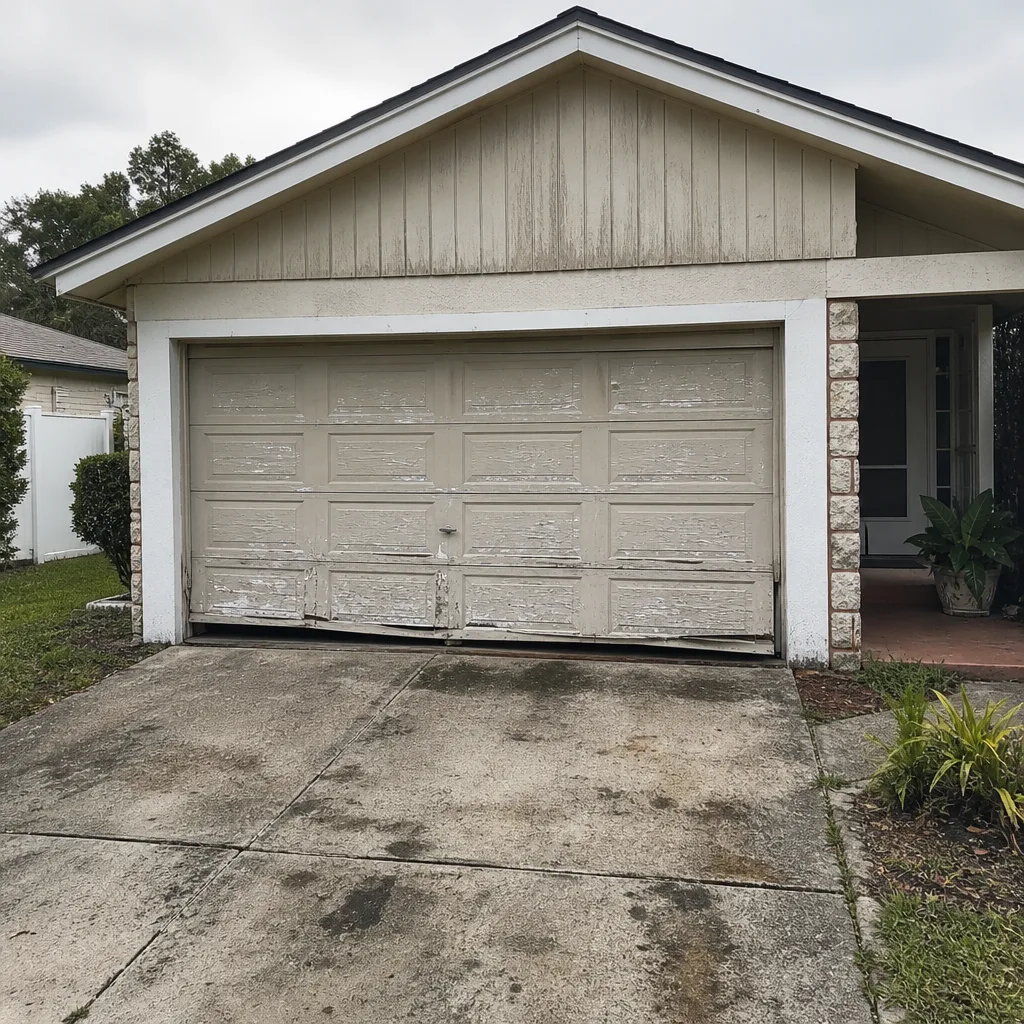 Before
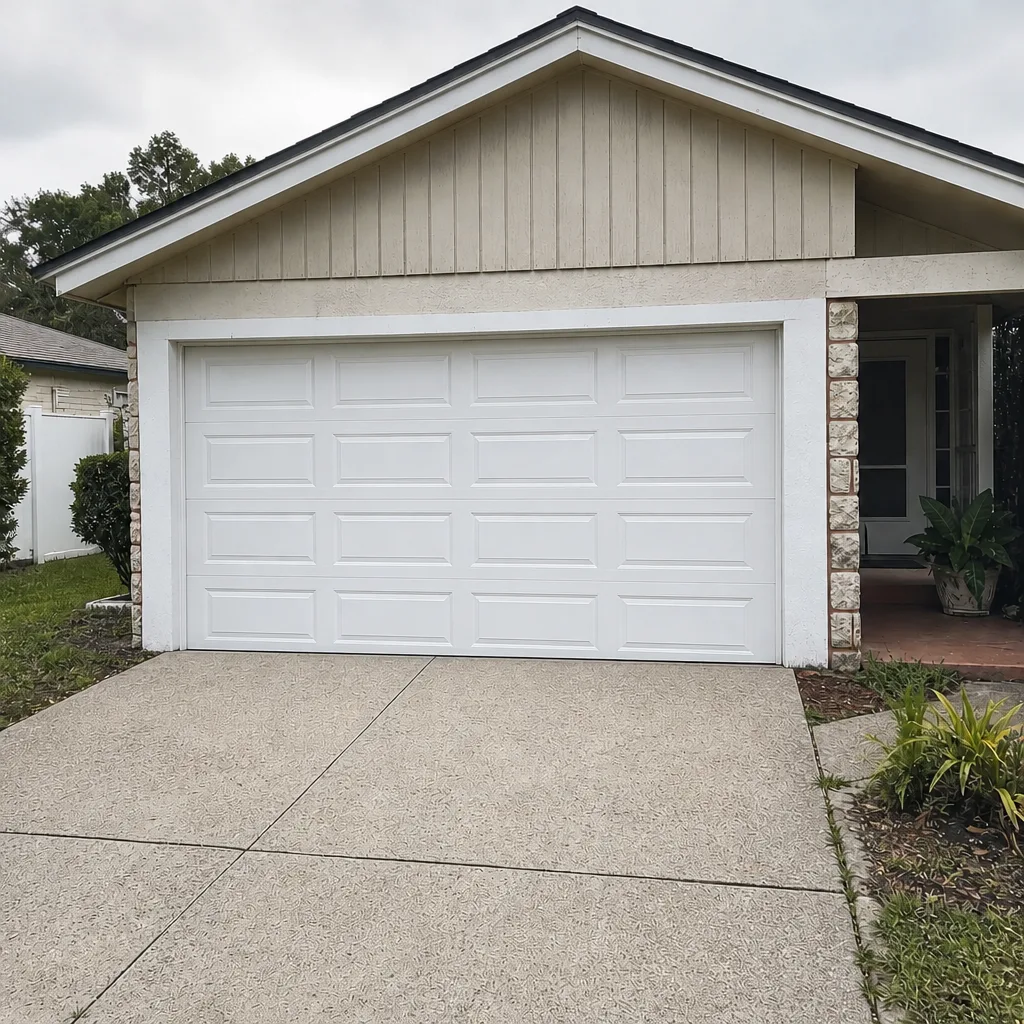 After
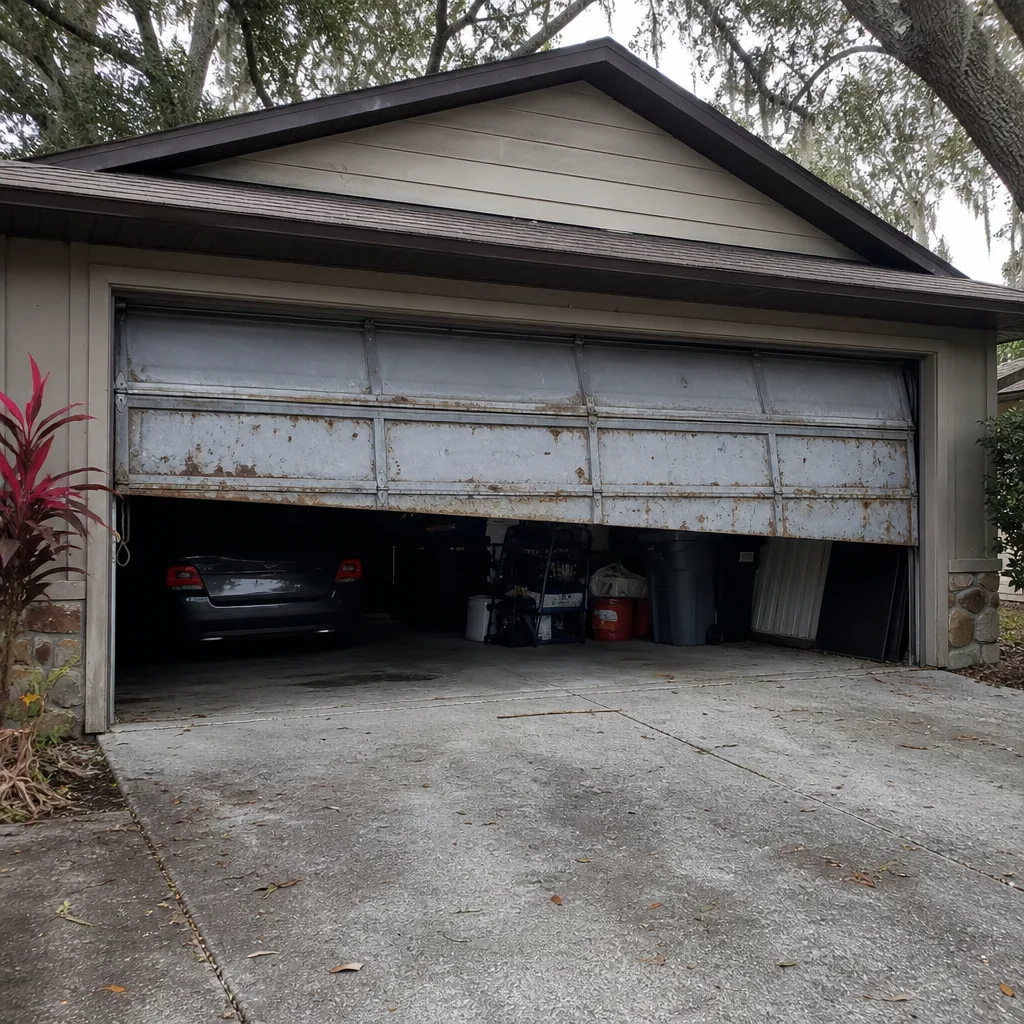 Before
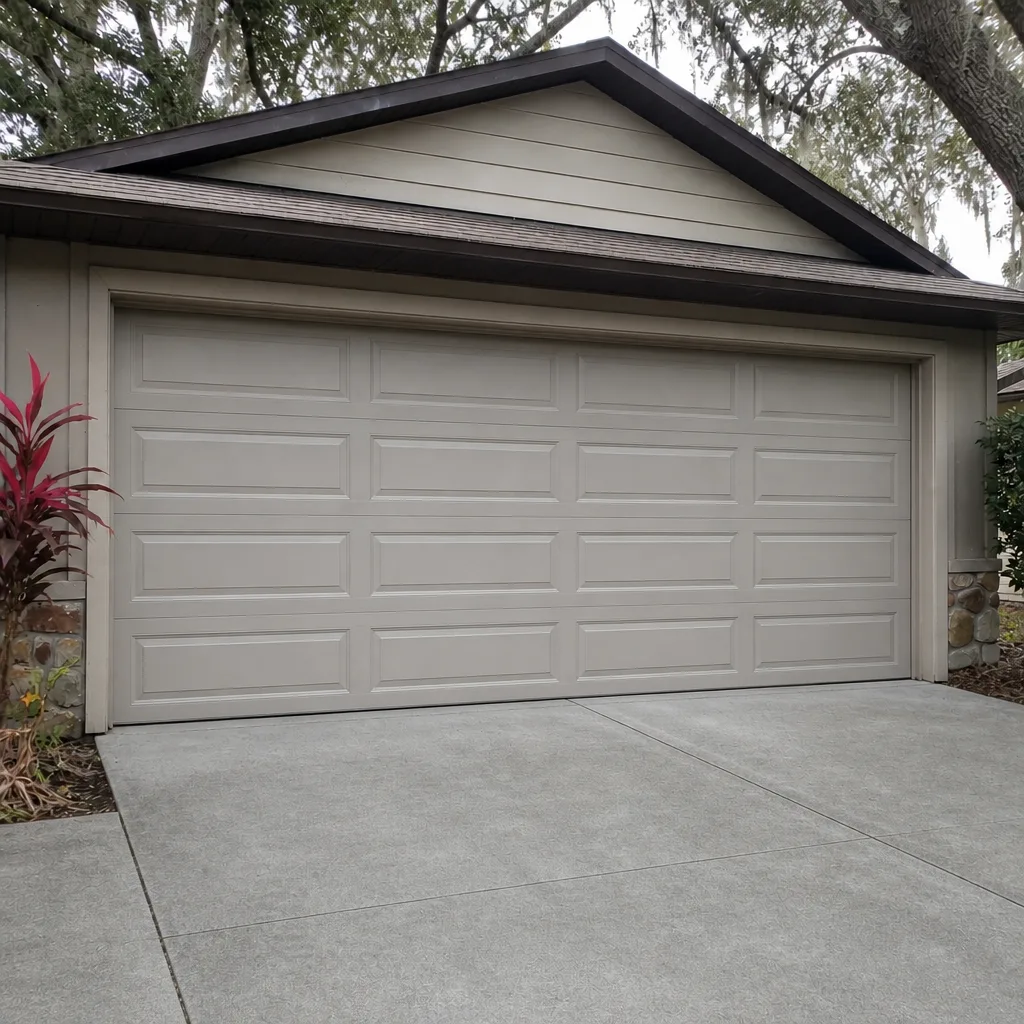 After
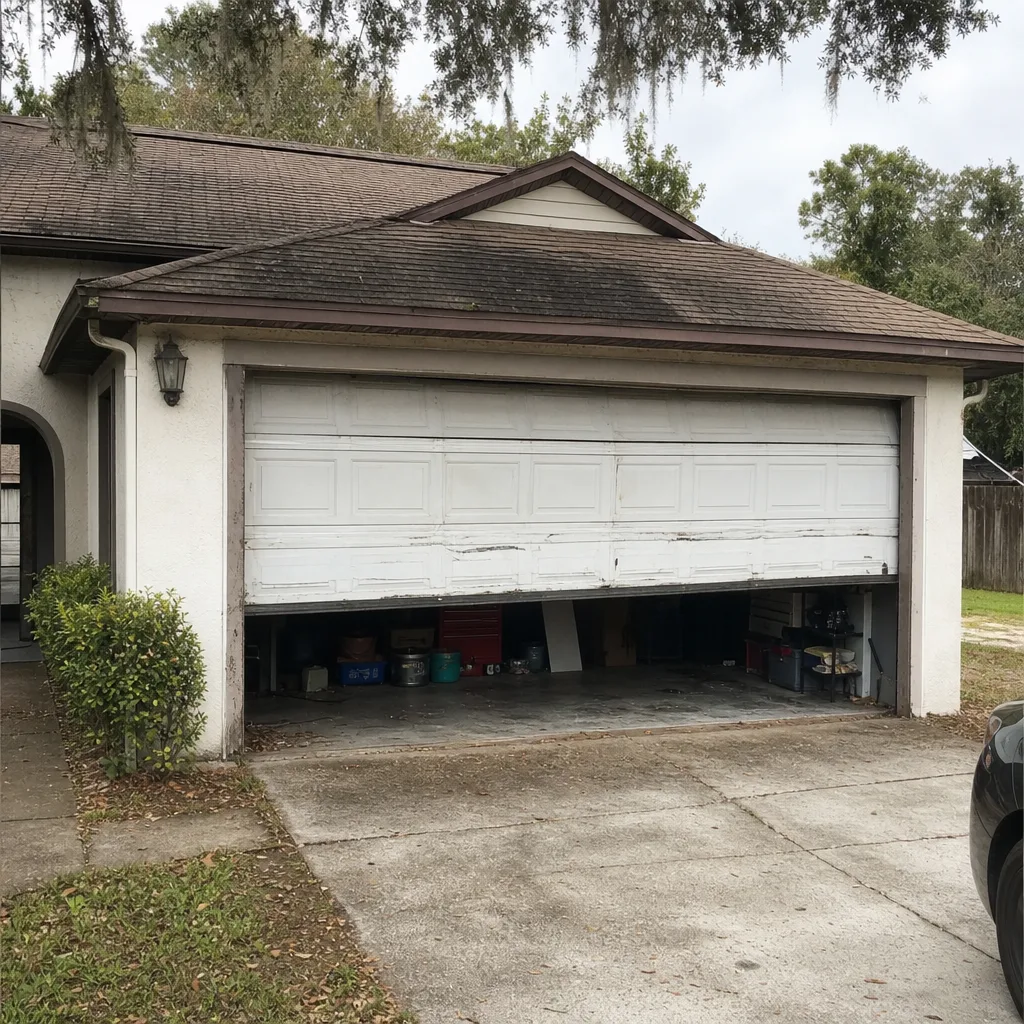 Before
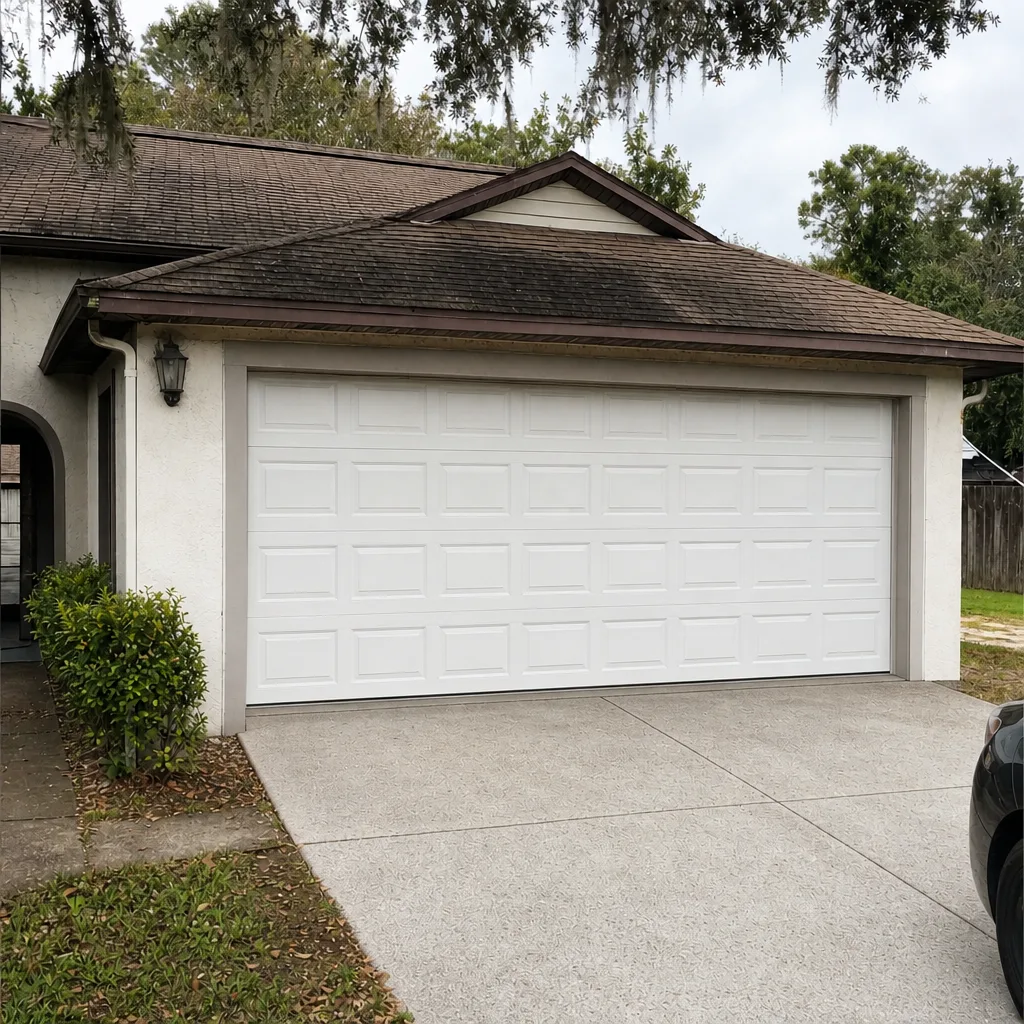 After
When to Call a Professional
Call a professional for any job in the red bucket: torsion spring replacement, cable replacement or re-spooling, bottom bracket work, panel replacement on an insulated or pressurized door, and any wiring that touches the household electrical panel. Also call if the door has dropped out of alignment after a car bump, if the opener shorts or trips a breaker, or if the door is making a sound you can’t identify. These are the signs that something structural is moving, and structural movement on a garage door is not a wear item, it’s a warning.
Apopka Garage Door Repair Co offers free estimates in Apopka. Call (844) 443-4734. We answer 24/7. Fast dispatch from 7am to 7pm, Sunday through Friday. When the door won’t move, we do. You’ll get a diagnosis, a written price set per job, and the full quote before any work starts.
Frequently Asked Questions
No. Torsion spring replacement requires professional winding bars and technique. The stored tension makes a DIY attempt a genuine injury risk, and it’s the most common source of hand and wrist injuries in the trade. Call Apopka Garage Door Repair Co at (844) 443-4734 for a free estimate.
Yes. Bottom weatherstrip replacement is one of the safest DIY garage door tasks. The old seal pulls out of a channel and the new one presses back in with no tools beyond a flathead screwdriver. Apopka humidity wears these seals faster than most homeowners expect, so check yours twice a year.
Extension springs are the older style, mounted along the sides of the track and stretching down. They’re easier to access than torsion springs but still carry stored energy and are not recommended for DIY replacement on a door with any real weight. Torsion springs, mounted on the header bar above the door, should never be a DIY job.
Full garage door replacements in Orange County typically require a permit. The permit confirms the door meets Florida’s high-wind rating and anchoring standards for your address. Call the Apopka building department to confirm the specifics for your job before you install anything.
Often, yes. Many opener manufacturers require licensed installation to keep the warranty valid, especially on smart openers and brands like LiftMaster. Check the specific warranty terms before you start, because a DIY replacement that fails in the first year can leave you covering the whole cost yourself.
Torsion spring replacement. The spring holds the full weight of the door under tension and releases with enough force to cause serious injury. There is no safe DIY version of this job. If a spring is broken, call a professional. Our team handles spring repair as a dedicated service, and Apopka Garage Door Repair Co offers free estimates: (844) 443-4734.
Repair first, in most cases. A door with a snapped spring, worn rollers, or a slow opener usually needs repair, not replacement. Apopka Garage Door Repair Co assesses the door and the opener together and gives you a written estimate for the fix. Replacement only makes sense when the door’s structure is compromised. Visit Apopka Garage Door Repair Co to see the full range of what we handle.
The Bottom Line
The DIY-vs-pro question for garage doors isn’t about whether you’re handy. It’s about which tasks carry stored energy and which don’t. Weatherstripping, lubrication, remote programming, and safety-sensor alignment are genuinely safe DIY work, and every Apopka homeowner should do them. Spring, cable, and structural work is red-bucket territory, and it belongs with a trained technician who uses the right tools and can pull the right permits. The permit side matters more in Orange County than most homeowners realize, since an unpermitted install can complicate your insurance and your resale. Do the maintenance yourself. Call for the rest.
If you’re not sure which bucket your job falls into, that’s the call to make. Call (844) 443-4734 for a free estimate. We answer 24/7, with fast dispatch from 7am to 7pm, Sunday through Friday. We’ll tell you what the door needs and what it doesn’t. No upsell, no guesswork, just a diagnosis and a fix.
Written by the team at Apopka Garage Door Repair Co.